There are two kinds of quiz most businesses build.
The first is the personality quiz: "Which type of leader are you?", "What's your money personality?". Everyone gets a fun label at the end, and most people share it.
The second is the scored assessment: "How healthy is your sleep?", "Is your website ready for paid ads?". Every answer counts towards a score, and the result tells people where they stand and what to do next.
Both collect email addresses. But if you sell advice (coaching, consulting, a programme, a service), they do very different jobs.
What a personality quiz is good at
A personality quiz works because the result is about the person, and people like reading about themselves. It's easy to take, easy to share and easy to write.
It's a good fit when:
- you sell products and each personality type maps to a product (a skincare routine, a coffee, a course level)
- you want reach more than depth, for example a quiz people pass around on social media
- your offer is the same for everyone and you mainly need a reason for people to sign up
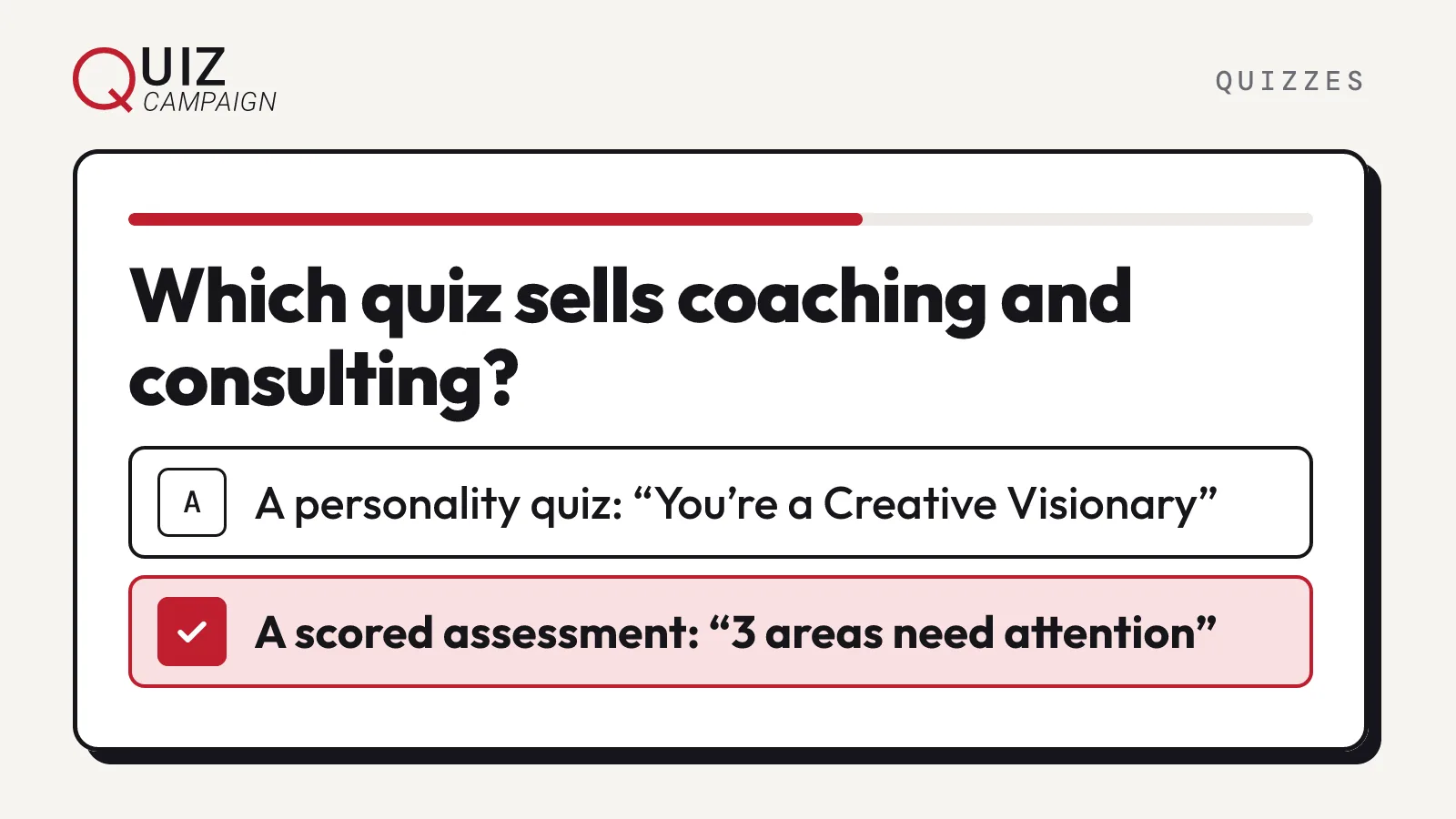
The weakness is that a label doesn't create urgency. "You're a Creative Visionary" is nice to hear. It doesn't tell anyone they have a problem worth paying to fix.
What a scored assessment is good at
A scored assessment measures something. Instead of a label, people get an answer to a question they actually care about: how am I doing, and what should I fix first?
That makes it a much better fit for selling advice, for three reasons.
1. It shows people the gap. Advice sells when someone sees the distance between where they are and where they want to be. A score makes that gap visible. A clear "you're doing well here, but this area needs attention" is far more persuasive than anything you could write on a sales page.
2. It shows you the gap. Every answer is saved with the lead. Before you ever speak to someone, you know which areas they scored low in. That's half a discovery call already done.
3. It points to your offer naturally. If someone scores low on the exact thing your programme fixes, recommending it isn't a pitch. It's the logical next step, and the person has just seen the evidence for themselves.
What a good assessment looks like
The fertility assessment built with QuizCampaign for a functional nutritionist is a good example of how this works in practice.
- 37 questions with picture answers, so it feels quick even though it's thorough. A progress bar shows how far along people are, and if someone skips a question, the quiz takes them back to it.
- Scores in 13 areas, each rated green, yellow or red. People see straight away which parts of their health are fine and which aren't.
- A personal report with the person's first name, an overall result and an explanation for each area.
- A recommendation for the nutritionist's programme, worded to match how serious the result is. Someone with mostly red areas gets a more direct recommendation than someone with mostly green.
Nobody finishes that quiz with a label. They finish it knowing where they stand, and with a clear reason to book a call.
How to choose
Ask yourself one question: what do you want people to do after the quiz?
| If you want people to… | Build a… |
|---|---|
| Share it and bring friends | Personality quiz |
| Buy one of several products | Personality quiz, with a product per result |
| Book a call or apply for a programme | Scored assessment |
| Understand why they need help | Scored assessment |
If you sell advice, a scored assessment is almost always the better choice. It does the convincing for you, and it gives you real information about every lead.
How to plan a scored assessment
- Pick the areas you measure. These are the parts of the problem you help people with. Five to fifteen areas is a good range. Fewer feels shallow; more gets hard to explain in the report.
- Write questions for each area. Two to four questions per area is usually enough. Ask about behaviour and symptoms people can actually answer, not opinions.
- Decide what counts as green, yellow and red for each area. Write this down before you write the results, so the scoring stays consistent.
- Write the report. For each area: what the score means, why it matters, and one thing the person can do about it.
- Link the result to your offer. Decide which scores lead to which recommendation, and how strongly you recommend it.
For more on writing questions and outcomes, see how to create your first quiz lead magnet and how to segment and qualify quiz leads.
The short version
Personality quizzes are great for reach and product recommendations. Scored assessments are better at selling advice, because they show people what needs fixing and show you who needs help.
If you'd like to see a scored assessment from first question to results page, book a demo and we'll walk you through one.